In the world of search engine optimization (SEO), one of the most critical aspects of optimizing your website is conducting thorough keyword research. Understanding how to do keyword research effectively can help drive targeted traffic to your site and boost your online visibility.
In this step-by-step guide, we’ll explore the importance of keyword research, how to get started, the tools you can use, how to choose the right keywords, and the significance of long-tail keywords. Let’s get started.
How to do keyword research: Before you start
Before diving into keyword research, it’s crucial to identify your niche. Understanding your niche helps you narrow down your keyword focus and target a specific audience. By focusing on a niche, you can tailor your content to meet the specific needs and interests of your target audience.
Identify your niche
Start by brainstorming the topics or themes that relate to your business or website. Determine what makes your offering unique and consider the types of questions your target audience may have. You might also explore your interests if your side hustle is a personal project.
Explore your passions
Begin by delving deep into your passions and interests. This is the foundation of your journey. Here’s how to explore them:
- Create a passion inventory: List everything you are genuinely passionate about, whether it’s cooking, gardening, technology, or travel. Don’t hold back — this is your moment to dream big.
- Reflect on what excites you: Take a moment to think about which of these passions genuinely excites you. Imagine yourself talking about it endlessly without getting bored. Those are the ones you should prioritize.
- Consider the practicality: While passion is crucial, consider the practicality of turning it into a niche. Ask yourself if there’s an audience interested in it. Are there problems or questions related to this passion that you could help solve or answer?
Define your expertise
Now that you’ve identified your passions, it’s time to narrow it down and define your expertise within them:
- Skills: Within your passions, list the skills you possess. For example, if your passion is cooking, your skills might include recipe creation, meal planning, or dietary expertise.
- Educational background and experience: Consider your education and any professional experience related to your passions. This can contribute to your expertise.
- What sets you apart: What makes you unique? Think about what differentiates you from others who share your passion. It could be a unique perspective, personal journey, or specialized knowledge.
Identify what makes your website unique
Every successful website has something that sets it apart from the rest. To identify what makes your website unique, follow these steps:
- Analyze your competition: Research other websites or content creators in your niche. Identify their strengths and weaknesses. What gaps can your website fill?
- Leverage your personal brand: Your personality and personal experiences are a unique asset. Use your personal anecdotes, stories, and journey to connect with your audience on a deeper level.
- Offer a distinct value proposition: Define what value your website provides to your audience that others don’t. Whether it’s a different approach, a unique voice, or more in-depth content, make it clear.
- Solve specific problems: Identify common issues or questions within your niche, and create content that effectively addresses them. This problem-solving approach can be a unique selling point for your website.
Understand your audience’s search behavior
Knowing how your audience searches for information online is crucial. Use tools like Google Analytics to gain insights into the keywords and phrases people are using to find your website. Look for patterns and trends in search behavior to better understand what your audience is looking for.
Think like your audience
To truly understand your target audience’s search behavior, you need to start by thinking like them:
- Walk in their shoes: Put yourself in your audience’s shoes. Consider their needs, problems, and questions. What would they search for to find answers?
- Create personas: Develop detailed audience personas. These are fictional characters that represent different segments of your audience. Define their demographics, interests, and pain points. This exercise helps you empathize with their search intentions.
Identify search intent
Understanding the intent behind your audience’s searches is crucial. Search intent generally falls into four categories:
- Informational: When your audience seeks information or answers to questions.
- Navigational: When they’re looking for a specific website or page.
- Transactional: When they intend to make a purchase or engage in an action.
- Commercial: When they’re researching a product or service before deciding to buy.
How to do keyword research: 3 types of tools to get you started
When it comes to keyword research, having the right tools can make all the difference. Fortunately, there are several options available that can help streamline your keyword research process and provide valuable insights. Let’s take a closer look at some of the most popular tools:
1. Google Keyword Planner
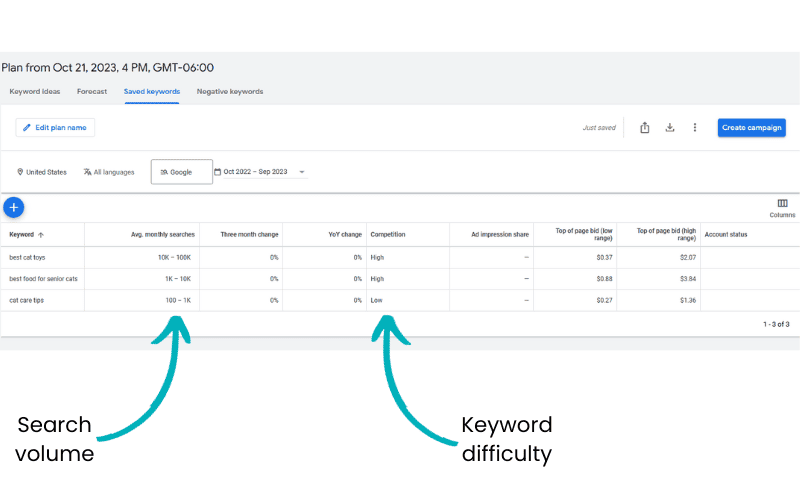
Google Keyword Planner is undoubtedly one of the most widely used tools for keyword research. As a free tool provided by Google, it offers a wealth of information to help you make informed decisions about your keyword targeting.
With Google Keyword Planner, you can enter relevant keywords and generate a list of related keywords. The tool also provides the average monthly search volume and the keyword difficulty (the level of competition for each keyword). By understanding the search volume and competition, you can prioritize your keyword targeting and focus on the most valuable opportunities.
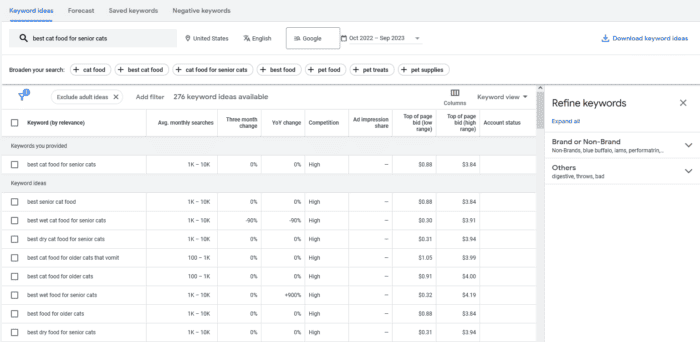
Google Keyword Planner also has a “Discover new keywords” option that lets you explore new keyword possibilities related to the primary keyword(s) you enter. You can also ask it to discover keyword opportunities by pasting a site URL into its search, which can be a great way to start competitor research. Armed with this information, you can refine your keyword strategy and stay ahead of the curve.
2. Semrush and Ahrefs
While Google Keyword Planner is an excellent starting point, it’s also worth considering other SEO tools to gain further insights into your competitors’ keyword strategies. These paid tools often allow you to do more in-depth research and gain more granular insights such as exact search volume rather than the range Google Keyword Planner provides.
Semrush
Semrush and Ahrefs are the two most popular tools for more in-depth keyword research and with good reason. Both offer an extensive toolkit to help you research, track, and discover keywords.
With Semrush, you can analyze your competitors’ organic and paid keyword strategies, identify keyword gaps, and discover new keyword opportunities. It excels in competitive analysis, allowing you to dissect your competitors’ strategies effectively.
By studying your competitors’ keyword strategies, you can gain valuable insights into what keywords are driving their success. This information allows you to refine your own keyword targeting and potentially outrank your competitors in search engine results.
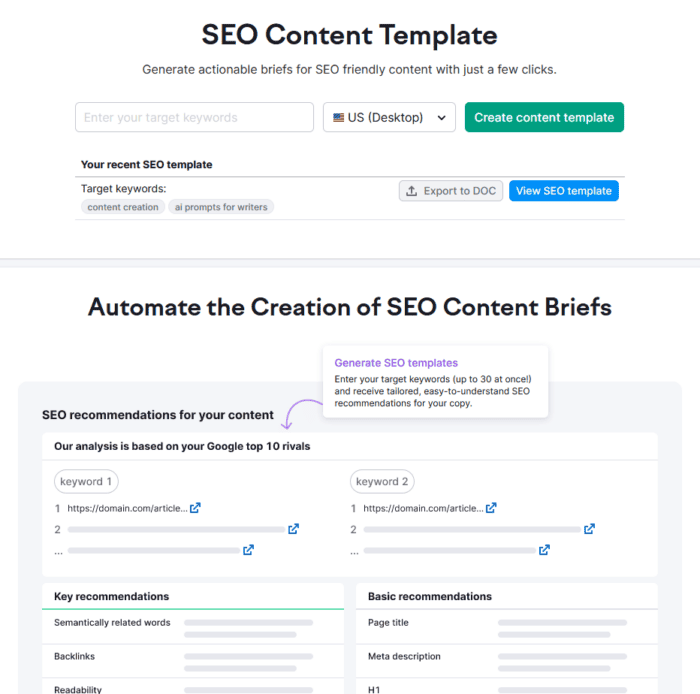
With its user-friendly interface, SEMrush is particularly suitable for beginners. It also provides an excellent content optimization toolkit, including automated SEO content briefs, making it easier to create SEO-friendly content.
Ahrefs
On the other hand, Ahrefs is known for its backlink analysis capabilities. It provides in-depth insights into your website’s backlink profile and helps you identify link-building opportunities. Ahrefs’ Keywords Explorer provides detailed keyword data and includes the “Clicks” metric, which estimates the actual traffic potential for specific keywords.
Ahrefs also boasts an extensive keyword database and offers detailed data on search volume and ranking positions. However, you might find Ahrefs’ interface a bit more complex compared to SEMrush.
One major drawback to both Ahrefs and Semrush is their cost. Ahrefs starts at about $80 a month and Semrush starts at about $105 a month, pushing them a bit out of range if you’ve just started a side hustle and haven’t made any money yet.
Some people recommend subscribing to one of these tools for at least a month and tackling six months’ to a year’s worth of SEO keyword research. Others suggest sharing an account with another solopreneur. But if you can’t make the cost of Ahrefs or Semrush work with your budget, there are some free keyword research tools to try as well.
3. Free keyword research tools
Ubersuggest
Created by digital marketing expert Neil Patel, Ubersuggest not only helps you find keywords but also gives you an overview of the competitive landscape. By creating a free account, you get three free keyword searches per day. If you prefer to upgrade, Ubersuggest’s pricing is a lot more palatable for new side hustlers at $29 a month.
AnswerThePublic
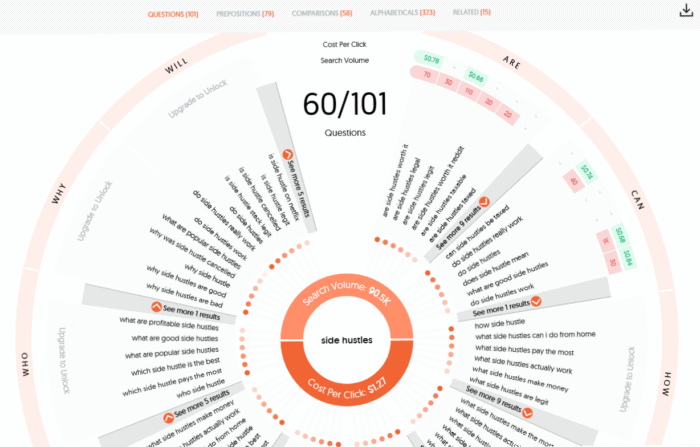
Imagine you could tap into the collective curiosity of the internet. Well, you can with AnswerThePublic. This tool offers insights into the questions people are asking about your topic, making it a goldmine for content ideas and FAQ sections.
Keyword Surfer
Made by Surfer SEO, another powerful keyword research tool, Keyword Surfer is a free Chrome extension that brings keyword insights right to your browser. It seamlessly integrates with your Google search, offering keyword data while you browse. It’s a nifty tool that helps you stay in the SEO game without opening your wallet.
Moz Keyword Explorer
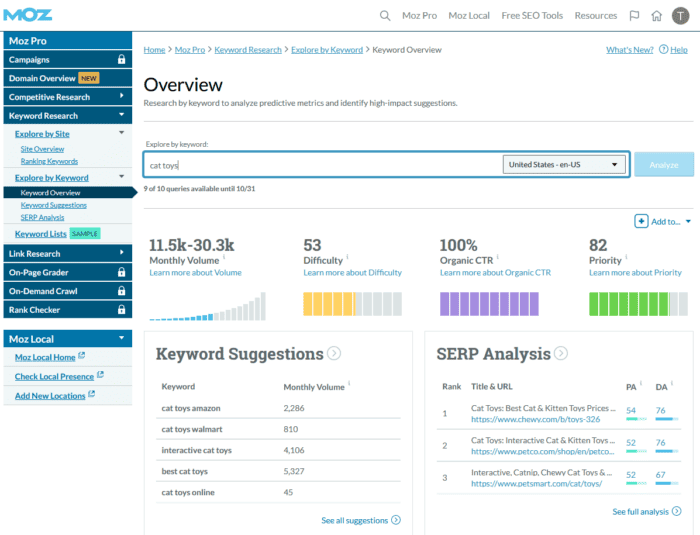
Moz’s free version of Keyword Explorer allows you to find and prioritize keywords. It also provides insights into keyword difficulty, helping you choose the most achievable targets. You’ll get 10 free searches per month, so use them wisely.
P.S. Grab the MozBar Chrome extension for free as well to see Google search insights as you browse the search engine results pages (SERPs).
Google Trends
Discover what’s trending in your niche with Google Trends. This tool provides insights into the popularity of keywords over time, helping you tailor your content to current interests. It might also help you spot a new topic to cover before it takes off.
Exploding Topics
Explore emerging trends and keywords with Exploding Topics. It’s a goldmine for content ideas that can give your side hustle a boost.
Mangools
Mangools offers a suite of SEO tools, including a free keyword research tool called KWFinder. It provides keyword suggestions, search volumes, and competitive data to help you make informed decisions. You’ll need to create a free account to see your results, but it’s well worth it considering Mangools has a handful of helpful free SEO tools.
Serpstat
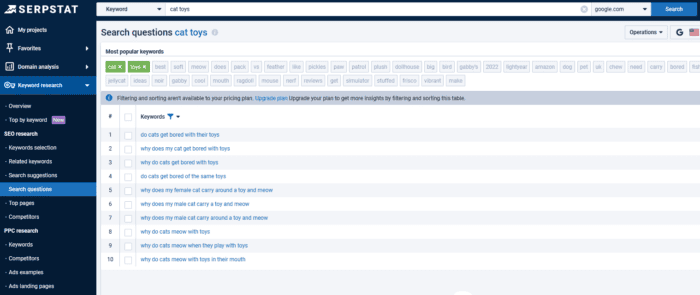
Serpstat‘s free plan offers keyword research features, including search volume, competition, and keyword trends. It’s a versatile tool for optimizing your content strategy, especially if you’re looking to expand into related keywords and questions. This is another tool where you’ll need to sign up for an account to access it for free.
Learn how to use ChatGPT for SEO research
Did you know you can use ChatGPT and other AI tools to do keyword research? Check out our 7 ChatGPT prompts for SEO research to get started.
How to do keyword research: Choosing the right keywords
Choosing the right keywords involves considering their relevance, search volume, and competition. By analyzing keyword relevance, you can ensure that the keywords you choose align with the content on your website. This helps search engines understand the context of your content and match it with users’ search queries.
1. Analyze keyword relevance
When evaluating a keyword’s relevance, consider whether it accurately represents the content on your website and aligns with your target audience’s search intent. Look for keywords that are specific, descriptive, and directly related to your products, services, or industry.
For example, if you have a website that sells organic skincare products, relevant keywords could include “organic skincare,” “natural beauty products,” “chemical-free skincare,” and “eco-friendly cosmetics.” These keywords accurately reflect the content on your website and are likely to attract users who are interested in organic skincare.
Furthermore, it’s essential to consider the search intent behind keywords. Put yourself in the shoes of your target audience and think about what they would search for when looking for products or information related to your industry. By understanding their search intent, you can choose keywords that align with their needs and expectations.
One way to double-check the relevance of a potential keyword is to open an incognito (or private) browser window and search for the keyword. Do the results that pop up match what you had in mind? Do the results cover the keyword topic using the angle you thought would be most appropriate?
If the answer is yes, then you’re on the right path.
2. Check search volume
While understanding keyword search volume is essential for optimizing your side hustle’s online presence, it’s equally vital to remember that the highest search volumes aren’t always the golden ticket to success. Instead, look for keywords with the following attributes:
- Low to moderate search volume
- Low keyword difficulty/competition
- Few or no well-known, large websites ranking on page one
The beauty of checking keyword search volume lies in its ability to reveal opportunities often overlooked by focusing solely on high-volume keywords. By exploring keywords with moderate search volumes, you can uncover hidden niches and untapped markets that may have lower competition, making it easier for your content to shine — especially if you’ve started a new site with low domain authority.
Choosing keywords is about striking a balance between search volume and competition as well as embracing a diverse mix of keyword volumes in your strategy. Even keywords with lower search volumes help you reach your target audience from various angles.
3. Evaluate keyword difficulty
Keyword difficulty refers to how hard it is to rank organically for a particular keyword. Consider the level of competition for each keyword you’re targeting and assess your ability to compete. High-competition keywords may be challenging to rank for, especially if you have a new or small website with low domain authority.
However, it’s important to strike a balance between keyword difficulty and search volume. While high search volume keywords often come with more competition, low-competition keywords may not drive significant traffic to your site.
Therefore, it’s crucial to evaluate both the keyword difficulty and search volume to find the sweet spot. Aim for keywords that have a reasonable search volume and a manageable level of competition or select a mix of high-volume and low-volume keywords. This way, you can maximize your chances of ranking well in SERPs and attract a steady stream of targeted traffic to your website.
Additionally, don’t forget to regularly monitor and update your keyword strategy. Search trends and user behavior can change over time, so it’s important to stay up-to-date with the latest keyword research. By continuously refining your keyword selection, you can adapt to evolving search patterns and maintain a competitive edge in your industry.
What are long-tail keywords and why should you target them?
In addition to targeting broad keywords, incorporating long-tail keywords into your content strategy can be highly effective. Long-tail keywords are highly targeted and specific search queries that typically have lower search volume but higher intent.
These keywords are more specific and usually longer phrases that cater to a particular niche or user question. For example, “best cat food” is a fairly broad keyword, but you can narrow it down to a specific niche with a long-tail keyword like “best cat food for senior cats.” This helps you reach a more specific audience and increases your chances of conversion.
Benefits of using long-tail keywords
By targeting long-tail keywords, you can attract highly motivated and qualified users who are closer to making a purchase decision.
Additionally, long-tail keywords often have less competition, making it easier for your website to rank higher in SERPs. Incorporating long-tail keywords into your overall keyword strategy can yield significant results.
Why is keyword research important?
Keywords play a significant role in SEO because they’re the search terms that users type into search engines when looking for information or solutions to their problems. By strategically incorporating relevant keywords into your website’s content, you can increase your chances of ranking higher in SERPs.
The role of keywords in SEO
Keywords are the building blocks of SEO. They signal search engines about how relevant your content is to users’ search queries. By targeting the right keywords, search engines can better understand what your website is about and match it with relevant search queries.
When you conduct thorough keyword research, you gain valuable insights into the language and terms your target audience uses to find information online. This research allows you to optimize your website’s content to align with those keywords, making it easier for search engines to understand and rank your website accordingly. Speaking the same language as your target audience also helps your content resonate with them and makes it easier to understand. As they say, “when in Rome…”
Moreover, keywords help search engines categorize and index your website’s pages. By strategically placing keywords in your page titles, headings, meta descriptions, and throughout your content, you provide search engines with clear signals about the topics and themes your website covers.
How keywords impact your website’s visibility
When you optimize your website for specific keywords, you increase your chances of appearing in relevant search results, leading to higher visibility and increased organic traffic. The more visible you are to your target audience, the more opportunities you have to attract potential customers and grow your online presence.
Don’t trade content quality for more keywords
Keyword optimization is not just about stuffing your content with as many keywords as possible, also called keyword stuffing. Search engines have become smarter in recent years and now prioritize high-quality, relevant content over keyword density alone. You might even get penalized by Google if you use underhanded SEO tactics like keyword stuffing.
Focus on creating valuable and informative content that naturally incorporates your target keywords. This approach not only helps you rank higher in search results but also enhances the user experience by providing valuable information to your audience.
Additionally, keywords can also influence other aspects of your SEO strategy, such as link building. When other websites link to your content using relevant keywords as anchor text, it signals to search engines that your website is a reputable source of information on that particular topic.
Effective keyword research is essential to your SEO strategy
Learning how to do keyword research is an essential step in any SEO strategy. By understanding the role of keywords and how they impact your website’s visibility, you can optimize your content to attract more organic traffic and increase your chances of reaching your target audience.